
By: ABRS- Academic Team
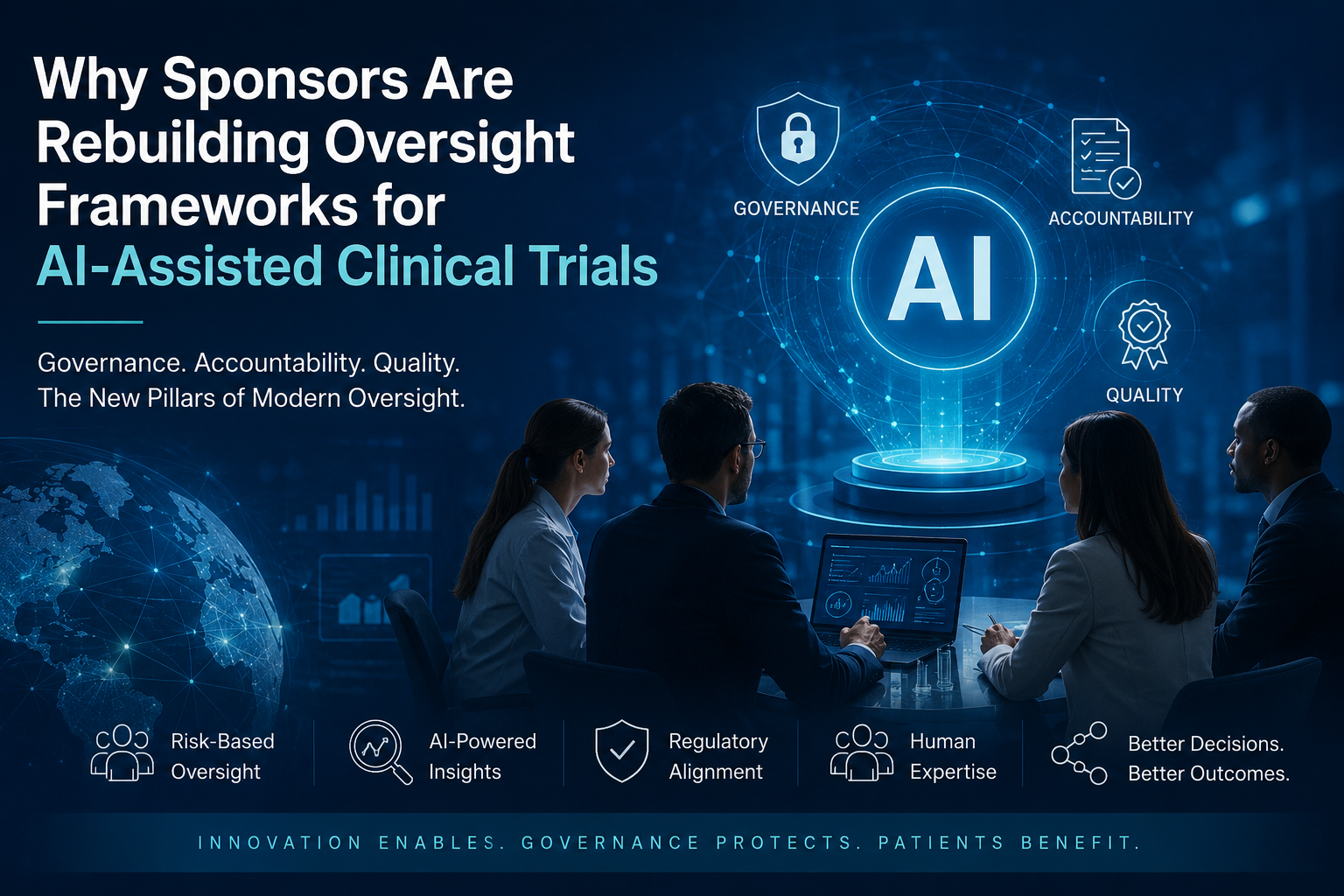
Introduction
The clinical research industry is entering a new operational era shaped by artificial intelligence (AI), decentralized trial models, increasing data complexity, and heightened regulatory expectations. While AI has demonstrated significant potential to accelerate workflows, improve risk detection, and enhance operational efficiency, it has also introduced new governance challenges for sponsors, CROs, and Functional Service Providers (FSPs).
As organizations adopt AI-assisted tools for monitoring, data review, signal detection, and operational analytics, the focus is shifting from simple technology adoption to accountability, oversight, and inspection readiness. Regulatory bodies and industry leaders are increasingly emphasizing that innovation without governance may create operational and compliance risks rather than efficiencies.
The evolution of ICH E6(R3), combined with growing industry discussions around AI literacy and risk-based quality management, is pushing sponsors to redesign oversight frameworks capable of balancing innovation with human accountability. Today, operational excellence is no longer defined solely by speed or scalability, but by the ability to maintain quality, transparency, and control in increasingly digital clinical trial environments.
AI Adoption Is Transforming Clinical Trial Operations — but Also Increasing Oversight Complexity
Artificial intelligence is rapidly becoming embedded across clinical development functions, including centralized monitoring, predictive analytics, protocol deviation detection, and workflow automation. According to McKinsey & Company (2024), AI-assisted operational models have the potential to improve clinical development productivity by accelerating data review processes and reducing operational bottlenecks (McKinsey & Company, 2024). Similarly, Deloitte’s 2025 Life Sciences Outlook highlights that life sciences organizations are increasingly prioritizing digital transformation and AI-enabled operational intelligence as part of broader modernization strategies (Deloitte, 2025).
However, the operational benefits of AI are accompanied by growing concerns around transparency, accountability, and decision-making oversight. The ICH E6(R3) Final Guideline reinforces that sponsors remain ultimately responsible for ensuring data integrity, participant safety, and quality management regardless of technological implementation (International Council for Harmonisation [ICH], 2025). This means that AI-assisted activities cannot function without clearly defined governance structures and human oversight mechanisms.
Industry discussions are also evolving in this direction. During the SCDM 2025 Regulatory Town Hall on ICH E6(R3) and Artificial Intelligence, experts emphasized that organizations adopting AI tools must establish frameworks that support traceability, validation, and harmonized oversight practices across global clinical operations (ClinicalResearch.io, 2025). Additionally, Cyntegrity (2026) notes that operational teams increasingly require training not only in technology use, but also in understanding AI limitations, accountability boundaries, and risk management responsibilities.
Together, these developments demonstrate that AI is not reducing the need for oversight. Instead, it is fundamentally redefining how oversight must be executed in modern clinical trials.
Risk-Based Governance Is Becoming Central to Modern Oversight Models

As clinical trials become more decentralized and data-intensive, traditional oversight models based on retrospective review and fragmented operational visibility are proving insufficient. Sponsors are increasingly adopting risk-based governance frameworks designed to proactively identify operational risks, prioritize critical data, and strengthen continuous quality management practices.
The ICH E6(R3) guideline strongly promotes a fit-for-purpose and risk-proportionate approach to clinical trial management, encouraging organizations to focus oversight efforts on processes and data that are critical to participant safety and trial reliability (ICH, 2025). This shift aligns with Deloitte’s 2025 outlook, which identifies operational resilience and adaptive governance as strategic priorities for organizations navigating increasingly complex clinical ecosystems (Deloitte, 2025).
McKinsey & Company (2024) further explains how predictive analytics and AI-enabled operational intelligence can improve risk identification and support faster decision-making across trial operations. However, the report also highlights that organizations must ensure governance structures evolve alongside technological capabilities to prevent inconsistent processes or poorly controlled automation.
Industry experts participating in the SCDM 2025 Regulatory Town Hall similarly emphasized that inspection readiness is becoming a continuous operational process rather than a reactive activity performed shortly before audits or inspections (ClinicalResearch.io, 2025). AI-assisted environments require organizations to maintain clear documentation practices, validation evidence, and decision traceability across systems and workflows.
Cyntegrity (2026) also reinforces the importance of operational readiness, arguing that successful AI implementation depends not only on software adoption but also on workforce preparedness, governance awareness, and cross-functional accountability. In this environment, risk-based governance is emerging as a competitive advantage rather than simply a compliance requirement.
Human Accountability Remains Essential in AI-Assisted Clinical Trials
Despite the growing sophistication of AI technologies, regulatory authorities and industry leaders continue to stress that human accountability remains essential in clinical research. AI may support operational decision-making, but responsibility for trial quality, patient safety, and regulatory compliance ultimately remains with sponsors and operational leadership teams.
The ICH E6(R3) guideline reinforces that sponsors must maintain appropriate oversight of delegated activities, including those supported by digital systems and third-party vendors (ICH, 2025). This expectation is particularly important in AI-assisted environments where algorithms may influence monitoring priorities, risk assessments, or data review activities.
McKinsey & Company (2024) highlights that organizations adopting AI successfully are typically those combining advanced analytics with strong governance, cross-functional collaboration, and operational expertise rather than relying solely on automation. Deloitte (2025) similarly notes that the future of life sciences operations will depend on balancing technological innovation with ethical responsibility, workforce adaptation, and governance maturity.
The SCDM 2025 discussions further underline that regulatory agencies are increasingly interested in understanding how organizations validate AI-supported decisions and maintain transparency around operational processes (ClinicalResearch.io, 2025). This creates a growing need for documentation standards, escalation pathways, and clear accountability structures.
Cyntegrity (2026) adds another important dimension by emphasizing that operational teams must understand not only how to use AI tools, but also when human intervention is required. AI-assisted operations demand professionals capable of interpreting outputs critically, identifying anomalies, and exercising informed judgment rather than passively relying on automated systems.
As a result, the future of clinical trial oversight will likely depend less on replacing human expertise and more on strengthening collaboration between technology, governance frameworks, and experienced operational leadership.
Conclusion:
The rapid adoption of artificial intelligence in clinical research is reshaping how sponsors manage oversight, quality, and operational execution. While AI-assisted technologies offer significant opportunities to improve efficiency and accelerate decision-making, they also introduce new expectations around governance, accountability, and continuous inspection readiness.
The evolution of ICH E6(R3) and ongoing industry discussions demonstrate that successful organizations will not be those adopting AI the fastest, but those implementing it responsibly within strong operational and quality frameworks. Sponsors, CROs, and FSPs must now build oversight models capable of integrating technological innovation with human expertise, risk-based governance, and transparent decision-making processes.
In this evolving landscape, operational intelligence is becoming a strategic differentiator. Organizations that successfully combine AI capabilities with governance maturity, workforce readiness, and proactive quality management will be better positioned to navigate complexity, maintain compliance, and drive sustainable clinical trial performance in the years ahead.
