
By: ABRS- Academic Team
Introduction
A GCP audit can reveal missing documentation, process deviations, gaps in oversight, and weaknesses in trial conduct. But the real value of an audit is not measured by the number of findings it produces. It depends on whether the auditor can understand what those findings mean, how significant they are, and whether they point to a broader weakness in the way a clinical trial is being managed.
That distinction matters because clinical research has become increasingly complex. Studies may involve multiple countries, sites, systems, vendors, functional teams, and operating models, all working within different regulatory and operational environments. In that setting, an auditor must do more than verify whether procedures were followed. The auditor needs the experience and professional judgment to evaluate how processes function in practice, recognize patterns across activities, ask the right questions, and determine when an observation may represent a more meaningful quality or compliance risk.
Independence is equally important. GCP auditing is intended to provide an objective assessment that is separate from routine monitoring and operational quality control. That independent perspective can help organizations identify issues that may be difficult to see from within day-to-day trial execution, while also providing insight into whether existing controls, responsibilities, and quality systems are working as intended.
For organizations managing complex clinical programs, including those supported through integrated service models such as ABRS’s FullSpectrum approach, the audit function fits within a broader quality framework rather than standing apart from clinical operations. Its value comes from remaining sufficiently independent to challenge processes objectively while still understanding the operational realities behind them.
The sections below explore why auditor experience matters, how skilled auditors look beyond individual findings to understand the process behind them, and how meaningful audit insight can contribute to stronger clinical trial quality.
Independent Perspective: What Experienced GCP Auditors Bring to Trial Quality
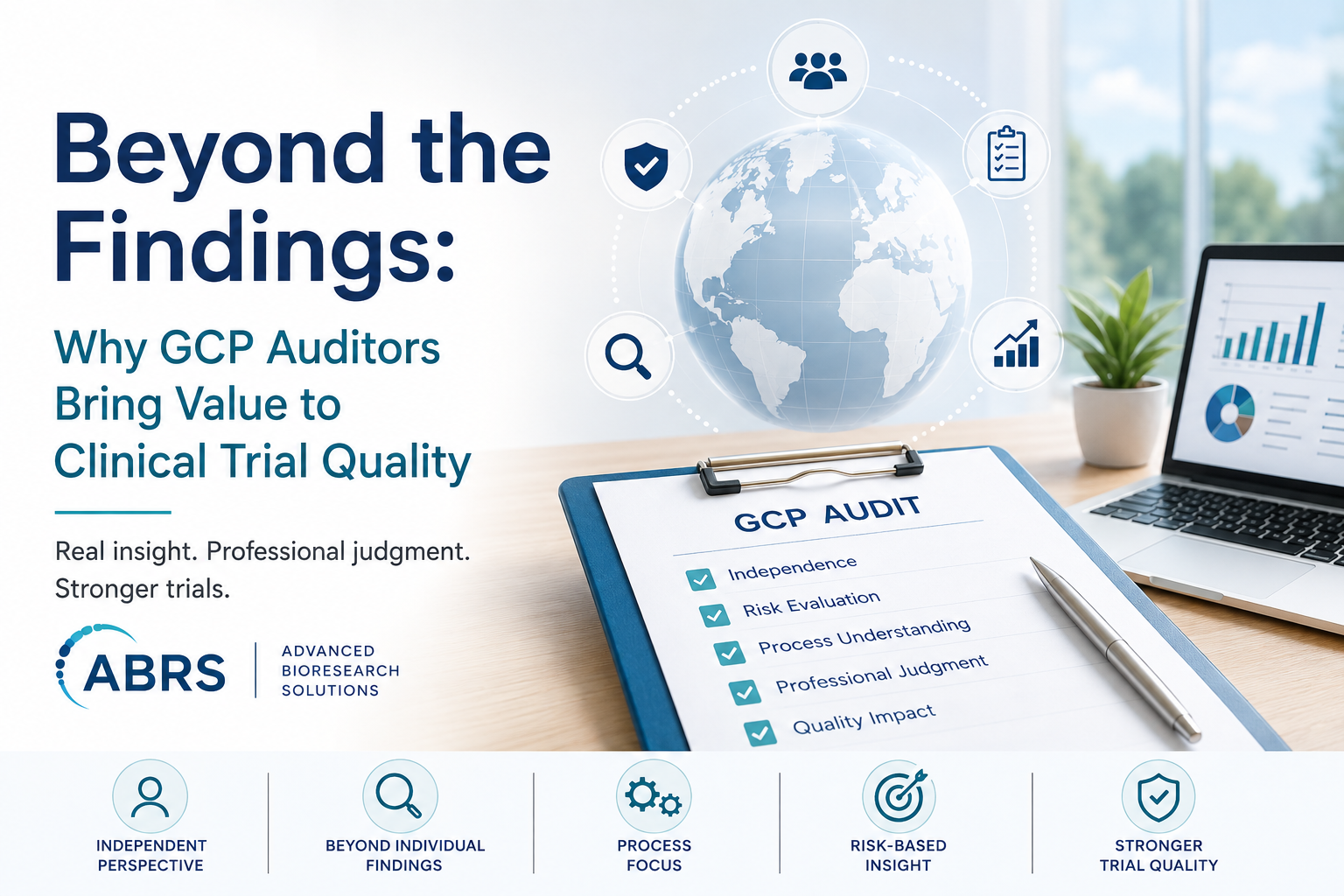
The value of a GCP audit begins with independence, but independence alone is not enough. An auditor must also have the experience to understand how clinical trial processes are intended to work, recognize when practice diverges from procedure, and judge whether an observation represents an isolated event or a more significant quality concern. This combination of objectivity and professional judgment is what allows an audit to provide insight that routine operational review may not capture.
The current ICH E6(R3) Guideline for Good Clinical Practice makes this distinction explicit. It defines sponsor auditing as an activity that is independent and separate from routine monitoring or quality control and states that its purpose is to evaluate whether the processes used to manage and conduct the trial are appropriate to ensure compliance with the protocol, GCP, and applicable regulatory requirements. ICH also requires auditors to be independent of the processes being audited and qualified through appropriate training and experience.
In practice, that experience matters because clinical trial auditing rarely consists of simple yes-or-no decisions. Procedures may be documented correctly while execution reveals inconsistencies. A finding that initially appears administrative may lead to questions about training, communication, oversight, or process design. Conversely, an unusual situation does not automatically indicate a systemic failure. An experienced auditor must evaluate the evidence in context, understand its potential impact, and determine how far an issue needs to be followed.
This need for professional judgment is also reflected in the Research Quality Association’s 2026 International QA Virtual Conference. Sessions focused specifically on audit practice emphasize that GxP auditing requires more than technical knowledge: auditors need judgment, interpersonal skills, risk assessment capability, and the ability to determine when an issue warrants escalation. Another session highlights that producing more findings does not necessarily mean producing a better audit and stresses the importance of following issues far enough to identify possible process deficiencies.
These skills become especially important in complex or global clinical programs, where auditors may need to assess activities performed across different sites, countries, systems, and functional teams. Their role is not simply to confirm whether documentation exists, but to understand how responsibilities, controls, and decisions operate across the trial environment and whether the available evidence supports confidence in those processes.
An effective GCP auditor therefore brings more than regulatory knowledge to the audit. Experience helps transform observations into meaningful quality insight by allowing the auditor to interpret risk, challenge assumptions appropriately, communicate findings constructively, and maintain an independent view of how the clinical trial is actually functioning.
Beyond Individual Findings: Identifying the Process Behind the Problem

A GCP audit becomes more valuable when it moves beyond documenting what went wrong and begins to examine why it happened. An isolated deviation may be straightforward to correct, but repeated or connected observations can point to weaknesses in training, communication, oversight, procedure design, or the quality management system itself. Experienced auditors therefore need to follow the evidence far enough to understand whether a finding represents a single event or a symptom of a broader process issue.
This process-oriented approach is described in Applied Clinical Trials — “Clinical Study Audits: The Quality Management Approach”. The authors, writing from a sponsor Quality Assurance perspective, explain how their audit methodology evolved beyond identifying individual non-conformances to examining the underlying process deficiencies associated with them. For example, an apparent protocol deviation may ultimately be connected to unclear instructions, ineffective training, inadequate communication, or a weakness in how the process was implemented. Identifying that broader process gap can provide a more meaningful basis for subsequent root-cause analysis and corrective and preventive action (CAPA).
This does not mean that the auditor is responsible for performing the organization’s root-cause analysis or designing the CAPA. Rather, the auditor’s role is to gather and evaluate sufficient evidence to describe the observation accurately, understand its potential significance, and identify where the process appears to have broken down. That distinction is important because a well-written finding should give the responsible team enough insight to investigate the underlying cause instead of simply correcting the individual example discovered during the audit.
Professional judgment is equally important when determining how much significance to assign to an observation. The Research Quality Association — 2026 International QA Virtual Conference includes practical audit sessions emphasizing that a larger number of findings does not necessarily indicate a better audit and that auditors should learn to follow issues far enough to identify possible process deficiencies. Other sessions focus on the judgment required to assess risk, determine when escalation is appropriate, and handle situations in which the correct response is not immediately obvious. These principles reinforce an important point: audit quality depends on the relevance and meaning of the observations, not simply their quantity.
The same risk-based thinking appears in the MHRA guidance on quality and risk proportionality in clinical trials. MHRA emphasizes focusing quality management and oversight on factors that can meaningfully affect participant protection and the reliability of trial results, rather than applying the same level of attention to every activity. The guidance also notes that Quality Assurance personnel often develop knowledge of issues across multiple functions and teams, giving them a broader perspective that can contribute to understanding where quality risks may exist, while audit independence must still be protected.
For the experienced GCP auditor, the objective is therefore not to create the longest possible list of observations. It is to distinguish what is isolated from what may be systemic, determine which issues carry meaningful quality or compliance implications, and document findings clearly enough that the organization can investigate and address the processes behind them. That is where auditing moves beyond detecting errors and begins to provide deeper insight into the health of the clinical trial quality system.
From Audit Insight to Stronger Clinical Trial Quality
The value of a GCP audit does not end when the audit report is issued. Its broader contribution comes from how clearly the findings are understood, how appropriately they are prioritized, and whether the organization uses them to strengthen the processes that support trial conduct. In this sense, a meaningful audit can provide more than a snapshot of compliance at a single point in time; it can help reveal where existing controls, responsibilities, or quality systems may need to be reinforced.
The ICH E6(R3) Guideline for Good Clinical Practice establishes auditing as an independent activity intended to evaluate whether the processes used to manage and conduct a trial are appropriate to ensure compliance with the protocol, GCP, and applicable regulatory requirements. It also emphasizes that audit planning should be proportionate to the importance of the trial, the risks to participants, the complexity of the study, and any identified problems. This supports a model in which audit findings are interpreted in context and used to focus attention where the potential quality impact is greatest. (ema.europa.eu)
Regulatory inspection experience also shows why audit capability matters. In MHRA Inspectorate — “Sponsor Oversight – Part 2”, one case study described an organization whose audit program was narrow in scope and whose QA manager had limited auditing experience. MHRA identified significant weaknesses in the quality management system and sponsor oversight that had not been adequately identified before inspection. While the case does not establish a simple cause-and-effect relationship, it illustrates that performing audits is not enough on its own; the scope, depth, and competence behind the audit function are critical to whether meaningful risks are identified. (mhrainspectorate.blog.gov.uk)
A similar principle appears in Applied Clinical Trials — “Clinical Study Audits: The Quality Management Approach”, where the authors describe how audit observations can be used to identify process deficiencies that may extend beyond a single site or study. When findings are translated into process-level insight, they can provide a stronger basis for root-cause analysis, CAPA, training, and broader quality improvement. The value lies not simply in correcting the example that was observed, but in understanding whether the same weakness could recur elsewhere if the underlying process remains unchanged. (appliedclinicaltrialsonline.com)
For organizations supporting complex clinical programs, this is where independent auditing becomes part of a broader quality framework. Within an integrated model such as ABRS’s FullSpectrum approach, GCP auditing can complement other clinical and quality functions by providing an independent view of how processes are operating across the trial environment. The key is preserving the separation required for objective audit while ensuring that findings can be translated into useful insight for the teams responsible for remediation and continuous improvement.
A strong audit function therefore creates value when independent observations lead to informed action. The objective is not simply to close findings, but to use audit insight to strengthen the systems, decisions, and quality controls that support reliable clinical trial execution.
Conclusion:
Experienced GCP auditors bring value not simply because they identify findings, but because they can interpret what those findings mean in the broader context of trial quality. Their independence, professional judgment, and ability to connect individual observations to underlying process weaknesses help organizations understand where risk may be developing and where existing controls may need to be strengthened.
As clinical trials become more complex and increasingly distributed across functions, systems, sites, and geographies, the need for meaningful independent assessment becomes even more important. Effective auditing requires more than procedural knowledge. It depends on the auditor’s ability to evaluate evidence in context, distinguish isolated issues from systemic concerns, and communicate findings in a way that supports appropriate follow-up without compromising audit independence.
Ultimately, a strong GCP audit function should do more than document noncompliance. It should provide credible, independent insight that helps clinical research organizations strengthen processes, focus corrective action where it matters most, and support a more resilient quality framework across the life of the study.
