
By: ABRS- Academic Team
Introduction
Clinical trial sponsors face an ongoing challenge: maintaining the specialized capabilities required to execute research programs while responding to changes in study timelines, geographic coverage, and operational demands. A clinical development portfolio may require different combinations of clinical monitoring, study start-up, regulatory support, pharmacovigilance, and oversight expertise at different stages of execution.
Building and maintaining every capability internally is not always practical. At the same time, outsourcing an entire clinical trial may not align with a sponsor’s existing infrastructure or preferred level of operational involvement. The Functional Service Provider (FSP) model offers an alternative by allowing organizations to obtain external support for selected clinical research functions while maintaining defined internal responsibilities.
The potential advantages of this arrangement are reflected in industry research. In the 2023 analysis Benefits of Clinical Development Outsourcing Models, Industry Standard Research reported that 61% of surveyed respondents using an internal-plus-FSP model identified increased resource flexibility as a benefit. The findings describe the experiences of participating organizations rather than establishing that every FSP arrangement produces the same results.
For sponsors, however, flexibility represents only part of the potential value. FSP arrangements can also provide access to specialized professionals, facilitate alignment with established operational systems, and support continuity across clinical programs.
Understanding these advantages requires examining how functional outsourcing can contribute to resource planning, sponsor oversight, and clinical trial execution without assuming that the outsourcing model alone determines study performance.
Resource Flexibility and Access to Specialized Clinical Expertise
One of the principal advantages of an FSP model is the ability to align clinical research resources with the evolving requirements of a sponsor’s development portfolio.
Clinical trials do not require the same level of functional support throughout their lifecycle. During study start-up, a sponsor may need extensive site activation and regulatory support. As recruitment and enrollment progress, clinical monitoring activities may become more prominent. Later, study closeout can require a different allocation of resources for documentation review, issue resolution, and final operational activities.
An FSP arrangement allows sponsors to plan functional capacity around these changing requirements rather than relying exclusively on a fixed internal workforce. Depending on the agreement, organizations may be able to increase regional monitoring coverage, introduce specialized support, or reassign resources as study priorities evolve.
The 2024 FSP Trends Report, published by the PPD clinical research business of Thermo Fisher Scientific, describes how sponsors use FSP and hybrid outsourcing arrangements to access specialized expertise and establish more adaptable resourcing strategies. The industry report also identifies recruitment capabilities, global operational coverage, and collaboration as important considerations when selecting an FSP partner. As a provider-sponsored report, its observations should be interpreted as industry perspectives rather than independent evidence of superior clinical trial outcomes.
Beyond resource availability, the ability to access appropriately qualified professionals is another important consideration.
Clinical research functions require distinct technical competencies, and not every organization maintains the same depth of expertise across therapeutic areas, technologies, and geographic regions. External functional support can help address capability gaps without requiring sponsors to develop every specialized role internally.
The 2024 peer-reviewed article Education and Training of Clinical Research Professionals and the Evolution of the Joint Task Force for Clinical Trial Competency, published in Frontiers in Pharmacology, examines the development of professional competency standards in clinical research. Sonstein and colleagues emphasize the importance of appropriate knowledge, skills, training, and continued professional development for personnel involved in clinical trial conduct and oversight.
For sponsors considering FSP support, these findings reinforce the importance of evaluating professional competencies rather than focusing exclusively on the availability of additional personnel.
Consider a hypothetical sponsor expanding a clinical trial into several Latin American countries. The organization may already have an experienced central clinical operations team but require additional professionals familiar with the relevant regional research environments, language requirements, and operational procedures.
An FSP arrangement may allow the sponsor to obtain qualified regional support while maintaining its existing study management structure. The professionals can contribute local operational knowledge while working within the responsibilities and processes established for the trial.
This approach may also support financial planning. Instead of maintaining permanent internal capacity for every potential workload, sponsors can evaluate resource requirements against defined functional assignments and contractual arrangements. Actual cost efficiency, however, depends on utilization, pricing structures, recruitment needs, training requirements, and the management of the relationship.
The value of flexibility therefore extends beyond increasing or reducing personnel numbers. It lies in matching specialized capabilities with the activities, locations, and stages of development where they are needed.
Maintaining Sponsor Control Through Integrated Functional Support

Another potential benefit of the FSP model is the opportunity to retain operational visibility while receiving external support for specific clinical research activities.
In many FSP arrangements, external professionals work within the sponsor’s established procedures, clinical systems, reporting structures, and governance framework. This creates an opportunity to extend functional capacity without necessarily introducing a separate operational infrastructure for every outsourced activity.
For example, a sponsor may engage external Clinical Research Associates (CRAs) who use its clinical trial management system, follow its monitoring procedures, and report findings through established communication channels. The sponsor continues to coordinate the clinical program while the assigned professionals perform their defined monitoring responsibilities.
This structure can help preserve consistency in documentation, escalation processes, and performance expectations across different studies. However, achieving that consistency requires appropriate onboarding, training, role definitions, and ongoing coordination.
The regulatory framework supports the need for clearly defined relationships. Under the ICH E6(R3) Good Clinical Practice guideline, Section 3.6.4 addresses the documentation of transferred trial-related activities, while Section 3.6.6 establishes that the sponsor retains ultimate responsibility for its trial-related activities, including participant protection and the reliability of trial data. Sections 3.6.8 and 3.6.9 further address access to service-provider information and appropriate oversight of important transferred activities.
These requirements establish an important distinction: operational responsibilities can be assigned to external providers, but outsourcing does not eliminate sponsor accountability.
An integrated FSP arrangement can support this regulatory obligation by allowing sponsors to establish direct communication channels, review relevant functional information, and maintain defined oversight processes.
Research into outsourcing oversight also demonstrates why the governance structure matters.
In the peer-reviewed study Assessing Outsourcing Oversight Practices and Performance, published in Therapeutic Innovation & Regulatory Science in 2020, Wilkinson and colleagues examined responses from 88 individuals involved in clinical development outsourcing. The study identified opportunities to improve sponsor oversight through stronger management involvement, communication, collaboration, and the use of technologies to monitor performance.
The findings do not establish that FSP models automatically provide better oversight than other arrangements. Instead, they demonstrate the importance of designing oversight processes that are appropriate for the outsourced activities.
The FDA’s 2023 guidance, A Risk-Based Approach to Monitoring of Clinical Investigations: Questions and Answers, provides additional context. It addresses the development of monitoring approaches, monitoring plans, and procedures for communicating and addressing findings. Although the guidance does not recommend a particular outsourcing model, its principles remain relevant when sponsors organize monitoring activities through external providers.
For sponsors, the advantage of integrated functional support lies in the possibility of strengthening execution while preserving established governance processes.
A well-defined arrangement can make it easier to determine who is responsible for completing an activity, which information must be communicated, and when an issue requires escalation to sponsor management.
This alignment also supports the principles described in the ICH E8(R1) General Considerations for Clinical Studies guideline, which emphasizes designing quality into clinical studies and identifying factors critical to participant protection and reliable results.
An FSP model does not replace these quality management principles. Its potential contribution is to organize external functional expertise in a way that remains connected to the sponsor’s existing quality and oversight framework.
Supporting Global Operations, Continuity, and Long-Term Clinical Development
For sponsors conducting studies across multiple regions, an FSP model may also provide advantages related to geographic coverage, operational continuity, and coordination across a portfolio of clinical trials.
Multinational studies involve different regulatory environments, institutional practices, languages, and site-level operational requirements. Sponsors must coordinate these differences while maintaining appropriate study-wide procedures and quality expectations.
Access to regional clinical research professionals can provide valuable operational support. Professionals familiar with local research environments may contribute knowledge of site practices, documentation processes, and applicable requirements that need to be considered during study execution.
However, regional expertise alone is not sufficient. Effective multinational operations also depend on how sponsor teams, external providers, and investigative sites communicate and distribute responsibilities.
The 2025 peer-reviewed article Developing and Streamlining Clinical Trial Services to Support Pediatric Drug Development Across 21 Countries in Europe: Insights From the conect4children (c4c) Network, published in Frontiers in Medicine, describes the implementation of collaborative clinical research services across a multinational network. The authors discuss the value of structured governance and a responsibility-assignment framework for clarifying interactions among sponsors, CROs, and other participating organizations.
Although this research evaluates a collaborative clinical research network rather than an FSP model specifically, it illustrates why well-defined roles and communication structures are important when multiple organizations contribute to trial activities.
Operational continuity is another consideration.
When professionals support several studies within the same sponsor organization, they may develop familiarity with its systems, procedures, documentation practices, and expectations. Retaining appropriately qualified personnel across assignments can reduce the need to repeatedly establish the same operational knowledge.
Continuity may also be relevant to relationships with investigative sites.
The 2026 article Harmonizing Interactions Between Clinical Trial Sponsors and Study Research Sites: An Appraisal of the Key Challenges and Recommendations for Addressing Them, published in the Journal of Clinical and Translational Science, examines operational barriers affecting research sites and discusses opportunities to strengthen collaboration with sponsors and CROs. The authors highlight the importance of communication, transparency, and sustainable partnerships.
For FSP-supported clinical operations, these findings suggest a practical opportunity: maintaining familiar communication channels and consistent functional practices may contribute to more predictable interactions between sponsors and investigative sites. Such benefits depend on personnel continuity and effective coordination; they should not be assumed to result automatically from functional outsourcing.
Recent benchmarking research provides a useful perspective on these advantages.
According to the September 2026 announcement of a Tufts Center for the Study of Drug Development benchmarking study, commissioned by Syneos Health, researchers examined data from 13 sponsor companies, 81 development programs, and 133 clinical trials. The announced findings indicated that no single sourcing model consistently outperformed the others across key measures of timeline, quality, and execution.
The findings, reported in the study sponsor’s press release, suggest that the design of the operating model, collaboration among service providers, and clearly established accountability may be more consequential than the choice of sourcing model alone.
This distinction is particularly relevant for sponsors evaluating the benefits of FSP arrangements. The potential advantage is not that functional outsourcing guarantees superior clinical trial performance. It is that the model offers a way to organize specialized capabilities around the sponsor’s specific operational needs.
At Advanced BioResearch Solutions (ABRS), the FullSpectrum FSP model is designed to provide adaptable functional support aligned with sponsor and CRO requirements. Its structure emphasizes integration with sponsor teams, regional clinical research expertise, and resource allocation across different phases of clinical trial execution.
Through clinical monitoring, study start-up support, auditing, and other specialized services, ABRS aims to strengthen functional capabilities while maintaining alignment with sponsor-established processes and responsibilities.
The organization’s Clinical Oversight Management (COM) service provides a complementary approach to structured operational oversight, including performance monitoring, risk identification, protocol adherence, and escalation processes according to the agreed scope of services.
Within this framework, the potential value for sponsors lies in combining specialized functional execution with appropriate communication, operational visibility, and oversight.
For organizations managing regional or multinational clinical development portfolios, this approach provides an opportunity to access external capabilities without requiring every activity to be organized through a fully outsourced study management arrangement.
Conclusion:
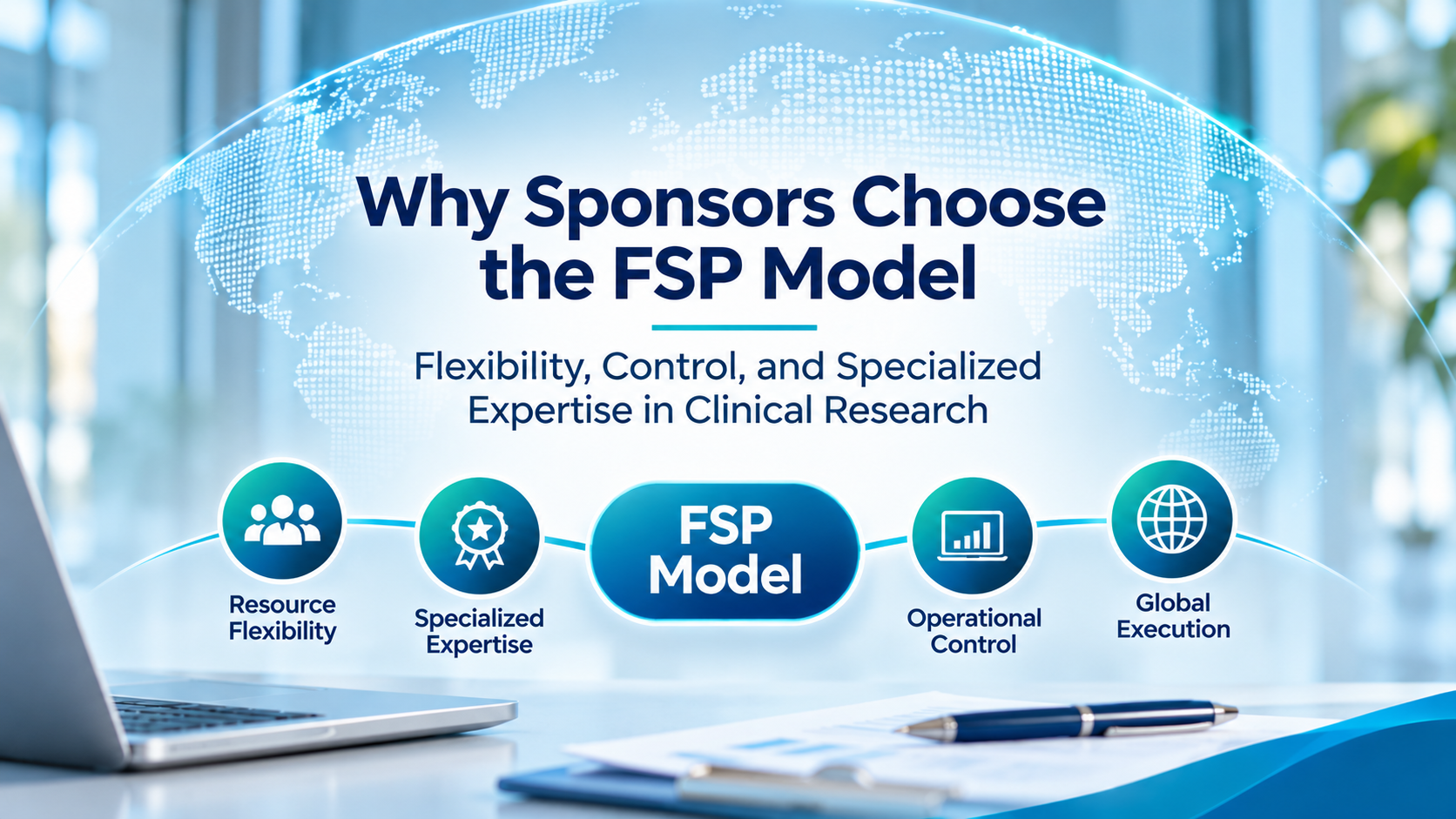
The Functional Service Provider model offers clinical trial sponsors several potential operational advantages, including resource flexibility, access to specialized expertise, integration with established clinical systems, and the ability to adapt functional support as development programs evolve.
These characteristics can be particularly valuable for organizations that wish to strengthen selected clinical research functions while maintaining defined internal responsibilities and visibility into study execution. Regional expertise and continuity across assignments may provide additional value when they are supported by appropriate onboarding, communication, and governance arrangements.
Nevertheless, the benefits of functional outsourcing depend on implementation. The selection of qualified professionals, clear allocation of responsibilities, suitable performance measures, and effective sponsor oversight remain essential considerations. No single outsourcing structure can guarantee shorter timelines, lower costs, or better clinical outcomes across every development program.
For sponsors evaluating an FSP arrangement, the central question is therefore not simply how many external professionals can be assigned to a study. It is whether those professionals can contribute the required expertise, integrate into existing processes, and support operational objectives within a clearly defined governance structure.
Through its FullSpectrum FSP approach, ABRS seeks to support these priorities by connecting specialized clinical research capabilities with sponsor-led operations and regionally informed execution.
The strategic value of an FSP model ultimately lies in its ability to align external expertise with the sponsor’s existing strengths, creating a functional partnership that supports adaptable, coordinated, and appropriately supervised clinical development.
