
By: ABRS- Clinical Insights Team
Abstract
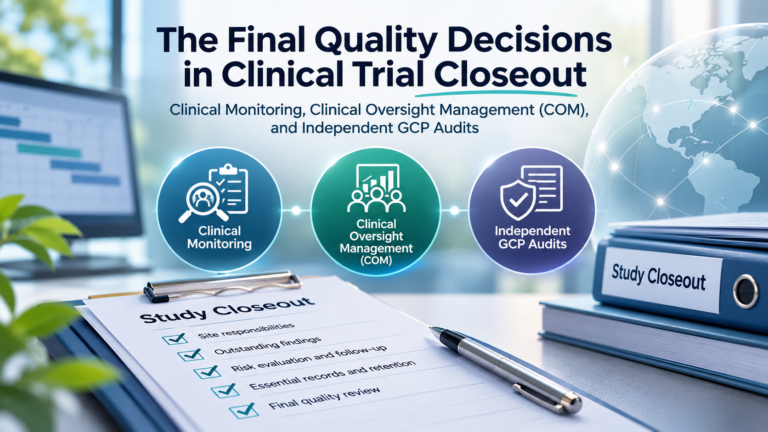
The completion of the last patient visit represents a significant milestone in clinical research, but it does not necessarily indicate that all operational and quality-related responsibilities have been fulfilled. During study closeout, Clinical Monitoring, Clinical Oversight Management (COM), and independent Good Clinical Practice (GCP) audits contribute distinct perspectives to the evaluation of outstanding activities, unresolved findings, and documented trial compliance.
Clinical Monitoring provides direct visibility into investigative site activities and the status of remaining responsibilities. Clinical Oversight Management supports sponsor-defined oversight through the evaluation of operational risks, monitoring findings, cross-site patterns, and escalation requirements. Independent GCP audits, when warranted, provide a separate assessment of the processes and evidence supporting trial conduct.
This article examines how these functions interact during clinical trial closeout while maintaining their respective responsibilities. Drawing on ICH E6(R3), regulatory guidance, and peer-reviewed research, it explores the importance of risk-proportionate monitoring, documented issue resolution, functional independence, and continued sponsor accountability. It also considers how specialized professionals operating within Functional Service Provider (FSP) arrangements may support the final stages of clinical trial execution without compromising the distinctions between monitoring, oversight, and independent quality assurance.
Introduction
The last patient last visit (LPLV) is frequently recognized as a defining milestone in clinical trial execution. It indicates that scheduled participant assessments have reached their endpoint, yet it does not necessarily mean that all trial-related responsibilities have been completed.
Investigative sites may still have unresolved monitoring findings, incomplete documentation, outstanding protocol deviation assessments, or investigational product accountability activities requiring follow-up. At the sponsor level, these remaining responsibilities may involve clinical monitoring professionals, clinical oversight specialists, and quality assurance personnel with different areas of expertise.
The International Council for Harmonisation of Technical Requirements for Pharmaceuticals for Human Use (ICH, 2025) establishes expectations for sponsor oversight, monitoring, quality management, and independent audits through ICH E6(R3). Sections 3.9 and 3.11 distinguish the sponsor’s oversight responsibilities from routine quality control and independent quality assurance activities.
Similarly, the U.S. Food and Drug Administration (FDA, 2023) identifies monitoring as a quality control activity and emphasizes the importance of risk-based strategies for evaluating trial conduct, reviewing findings, and determining appropriate follow-up.
These expectations are relevant during closeout because not every outstanding finding has the same implications. Some issues may require routine administrative completion, while others may demand additional evaluation due to their potential impact on participant protection, protocol compliance, or the reliability of trial results.
The distinction between Clinical Monitoring, Clinical Oversight Management (COM), and independent GCP auditing is therefore particularly important. Monitoring generates information about site conduct and identifies issues requiring attention. COM can support the sponsor’s broader visibility into those issues, their significance, and the status of appropriate responses. Independent auditing examines selected processes and records from a separate quality assurance perspective.
Within an FSP structure, specialized professionals may contribute to these activities while operating under sponsor-defined responsibilities and procedures. Understanding how their roles intersect, without treating them as interchangeable, provides a basis for examining the final quality decisions required during clinical trial closeout
Clinical Monitoring: Establishing the Final Status of Site-Level Responsibilities
Clinical Monitoring remains relevant after the completion of participant visits because the final operational status of an investigative site depends on more than the conclusion of scheduled clinical assessments.
ICH E6(R3), Section 3.11.4.5.2, includes specific monitoring activities associated with investigator site closeout. These include confirming arrangements for the retention of essential records and the final accountability of investigational products, as applicable (ICH, 2025). The guideline also addresses the review of relevant trial data, documentation of deviations, and communication of findings that require corrective action.
These expectations establish an important distinction between completing a monitoring visit and confirming that all responsibilities identified during that visit have been appropriately addressed.
Depending on the monitoring plan and study-specific procedures, Clinical Research Associates (CRAs) may need to review outstanding data queries, assess the status of protocol deviations, confirm documentation availability, and evaluate investigational product reconciliation records. The extent of these activities should remain proportionate to the risks associated with the trial.
The National Center for Complementary and Integrative Health (NCCIH, n.d.) provides a practical example through its guidance on closeout visits. Within its monitoring program, the organization identifies activities such as reviewing essential documents, verifying informed consent records, assessing outstanding data queries, and confirming investigational product disposition and record retention arrangements.
Importantly, NCCIH explains that not all closeout activities must necessarily be completed before the closeout visit. Remaining actions may require subsequent follow-up. These procedures are specific to NCCIH-supported studies and should not be interpreted as universal requirements for every sponsor.
Consider an investigative site that has completed all participant visits but still has an unresolved protocol deviation involving an assessment relevant to the trial’s primary endpoint.
The CRA may confirm the documentation available at the site, communicate the outstanding issue, and record the required follow-up. However, the conclusion of the monitoring visit does not establish whether the deviation has affected the reliability of the relevant data.
That determination may require further evaluation by appropriately qualified sponsor personnel.
ICH E6(R3), Section 3.11.4.6, addresses monitoring reports and the documentation of significant findings, conclusions, actions required, and follow-up on unresolved issues (ICH, 2025). These requirements emphasize that monitoring records must provide sufficient information to understand both the findings and the response undertaken.
For FSP-supported Clinical Monitoring, the relevant capability is therefore not limited to completing assigned site visits. It also includes the professional judgment necessary to recognize significant observations, communicate them appropriately, and document the status of activities within the assigned monitoring responsibilities.
The final monitoring review should establish a reliable account of what has been completed, which issues remain outstanding, and what follow-up is required.
Clinical Oversight Management: Maintaining Visibility Over Remaining Risks
Clinical Oversight Management (COM) provides a broader perspective on study execution by connecting monitoring information with the sponsor’s oversight requirements, operational priorities, and established escalation processes.
Unlike routine site monitoring, COM may consider findings across multiple sites, regions, and functional activities. Its role within an FSP arrangement should be defined by the services agreed upon with the sponsor. COM is an ABRS service designation, not a separately mandated regulatory function under ICH E6(R3).
The regulatory foundation for its activities can be found in the sponsor oversight principles of ICH E6(R3). Section 3.9 establishes that sponsors should maintain oversight measures appropriate to the complexity and risks of the trial. It also emphasizes timely escalation, follow-up of identified issues, and appropriate oversight of activities performed by investigators and service providers (ICH, 2025).
These expectations have particular relevance during study closeout, when operational teams may face pressure to complete remaining milestones while different sites still have unresolved findings.
Consider a multinational clinical trial in which three investigative sites have completed their final participant visits.
At the first site, monitoring identified an incomplete essential record. At the second, investigational product reconciliation remains outstanding. At the third, a protocol deviation requires further assessment because it may affect data associated with a significant trial endpoint.
Although all three sites have pending activities, the implications are not necessarily equivalent.
Within an appropriately defined COM scope, clinical oversight professionals may consolidate information from monitoring reports, examine the significance of outstanding findings, identify cross-site patterns, and coordinate escalation to the relevant sponsor personnel.
This differs from simply maintaining an operational checklist. The purpose is to ensure that the sponsor has sufficient visibility to distinguish routine completion activities from matters requiring additional clinical, regulatory, or quality-related assessment.
The FDA (2023) recommends procedures for reviewing monitoring results and communicating findings that may require further investigation or corrective action. Its guidance supports monitoring approaches tailored to the risks associated with the trial rather than uniform activity levels applied without regard to their significance.
Research on centralized monitoring offers additional context. In an analysis of 1,111 investigative sites across 159 clinical trials, de Viron et al. (2024) observed improvements in statistical data-quality indicators at many sites following investigation of identified risk signals.
The study used data from one commercial central monitoring platform, and several authors had commercial affiliations with its provider. Consequently, the findings should not be interpreted as proof that a particular monitoring technology, operational model, or FSP arrangement necessarily produces better outcomes. Nor was the study specifically designed to evaluate closeout performance.
Nevertheless, it provides evidence relevant to the potential value of identifying and investigating quality signals during trial execution.
From a COM perspective, the operational implication is that findings should be assessed in sufficient time to determine whether meaningful interventions remain possible. During closeout, certain issues may be corrected through additional documentation or clarification, while others may require an evaluation of their impact on the trial record.
ICH E6(R3), Section 3.12, further distinguishes proportionate responses to noncompliance from situations in which significant noncompliance requires root cause analysis, corrective and preventive actions, and appropriate notification when applicable (ICH, 2025).
COM can support the visibility, coordination, and documented follow-up necessary for these decisions, without assuming medical or regulatory authority that remains with designated sponsor personnel.
Its contribution during closeout is therefore best understood as a form of structured clinical oversight: connecting site-level findings with their wider implications and helping ensure that unresolved issues receive appropriate attention before relevant operational responsibilities conclude.
Independent GCP Audits: Evaluating Processes Beyond Routine Monitoring
Clinical Monitoring and Clinical Oversight Management contribute to ongoing study oversight, but neither is equivalent to an independent GCP audit.
ICH E6(R3), Section 3.11.2, distinguishes sponsor auditing from routine monitoring and quality control. An audit evaluates whether the processes used to manage and conduct the trial are appropriate for meeting the protocol, GCP, and applicable regulatory requirements (ICH, 2025).
The guideline also specifies that auditors should be independent of the trial activities or processes being audited and qualified through appropriate training and experience.
This requirement is relevant when monitoring, COM, and auditing services are supported by external functional professionals. Personnel responsible for performing or overseeing particular trial activities should not independently audit those same activities.
The audit function must therefore remain distinct even when the professionals involved are engaged through a common service provider.
During study closeout, an independent audit may assess selected aspects of trial conduct and documentation, depending on the sponsor’s audit program and the identified risks.
For example, an audit may examine how significant monitoring findings were documented, whether escalation procedures were followed, whether relevant corrective actions were evaluated, and whether essential records support the reported conduct of the trial.
The European Medicines Agency (EMA, n.d.) identifies several concerns encountered during GCP inspections, including unclear contractual responsibilities, incomplete trial master file documentation, and insufficient clarity regarding which organization is responsible for generating, maintaining, or archiving particular records.
Although a sponsor audit and a regulatory inspection are different activities, these observations illustrate the importance of traceability and clearly assigned responsibilities when multiple organizations contribute to trial execution.
This is particularly relevant during closeout because access to systems, personnel, and externally maintained records may change as operational activities conclude.
An independent audit may therefore evaluate whether applicable procedures were implemented and whether sufficient evidence is available to support the activities performed.
However, its purpose is not to assume the responsibilities of the CRA or COM personnel. The auditor should not become responsible for completing the monitoring actions or operational corrective activities that the audit function may subsequently evaluate.
The distinction also applies to the interpretation of findings. An audit observation does not automatically establish serious noncompliance. Its significance must be evaluated against the applicable regulatory requirements, the processes involved, and its potential consequences.
ICH E6(R3) requires audit activities to be proportionate to trial risks. It does not mandate an independent GCP audit at the closeout of every clinical trial (ICH, 2025).
Accordingly, sponsors should determine whether an audit is warranted based on the audit strategy, relevant risk signals, the nature of previously identified findings, and other applicable considerations.
In an FSP-supported environment, the contribution of independent GCP auditors rests on the combination of technical expertise, objective assessment, and separation from the processes under review.
This independent perspective complements monitoring and COM but should not be described as a substitute for either function.
Functional Integration Without Blurring Responsibilities in the FSP Model
Clinical trial closeout demonstrates why functional integration requires more than assigning multiple professionals to the same study.
Clinical Monitoring, Clinical Oversight Management, and independent GCP auditing contribute different types of information and judgment. Their activities may intersect, but their purposes and decision-making boundaries must remain distinguishable.
In a sponsor-integrated FSP structure, monitoring professionals may conduct the assigned site-level reviews and document outstanding findings. COM professionals may support oversight of monitoring activities, evaluation of risks across sites, coordination of escalations, and visibility into unresolved operational responsibilities.
Independent auditors, when engaged, evaluate the relevant processes without participating in the execution or oversight of the activities they are assigned to audit.
The sponsor remains responsible for defining these activities, maintaining appropriate oversight, and determining how significant findings should be addressed.
ICH E6(R3), Section 3.6, recognizes that sponsors may transfer trial-related activities to service providers through documented agreements. Nevertheless, ultimate responsibility for sponsor trial-related activities, including participant protection and the reliability of trial results, remains with the sponsor (ICH, 2025).
This principle is especially relevant when services are delivered through embedded functional professionals who operate within sponsor systems and procedures.
Consider a hypothetical study approaching final site closeout. A CRA identifies a discrepancy involving investigational product accountability. The finding is documented and communicated in accordance with the monitoring plan.
The COM function, within its assigned scope, may evaluate whether the discrepancy is isolated, whether comparable issues have occurred elsewhere, and whether escalation to the sponsor’s quality or clinical personnel is warranted.
The sponsor’s designated personnel determine the appropriate response, taking into account the available evidence and applicable procedures.
If the sponsor’s independent audit program identifies a need to evaluate the investigational product accountability process, qualified auditors may examine the relevant records, procedural implementation, and management of identified discrepancies.
These activities are connected, but they are not interchangeable.
The CRA contributes direct information from site monitoring. COM supports sponsor visibility into the issue and its wider operational implications. The independent auditor, if an audit is conducted, assesses the applicable process without participating in its execution or remediation.
The FDA (2023) emphasizes that monitoring should focus on risks that matter to trial conduct and data reliability. In an integrated operational model, this principle can inform the information that monitoring professionals communicate and the issues that COM may need to follow up within its defined responsibilities.
Similarly, the EMA (n.d.) highlights the importance of clearly documented responsibilities when sponsors rely on contracted service providers. This consideration is particularly relevant when trial activities involve several organizations and records must remain accessible after operational services end.
Within ABRS’s FullSpectrum FSP model, Clinical Monitoring and Clinical Oversight Management provide a relevant context for the contribution of specialized professionals within sponsor-directed clinical operations. Independent GCP auditing can complement those functions when appropriately assigned, provided the required independence is maintained.
The value of this structure should not be assessed solely through the number of professionals assigned or the speed with which closeout milestones are completed.
More meaningful considerations include whether monitoring findings are accurately documented, whether significant risks are appropriately escalated, whether assigned follow-up is completed and supported by evidence, and whether independent quality assurance activities maintain their objectivity.
These considerations demonstrate that functional integration and clear responsibility boundaries are complementary requirements rather than competing objectives.
During study closeout, appropriately defined monitoring, COM, and auditing responsibilities can help sponsors understand the remaining state of trial execution while preserving their own accountability for final decisions.
Conclusion
Clinical trial closeout is not simply the administrative consequence of completing the last participant visit. It is a stage in which outstanding monitoring findings, operational risks, documentation requirements, and quality-related decisions must receive appropriate attention.
Clinical Monitoring establishes direct visibility into the status of investigative site responsibilities. Clinical Oversight Management connects that information with broader risk evaluation, escalation, and sponsor oversight requirements. Independent GCP audits, when warranted, provide a separate assessment of the processes and evidence supporting trial conduct.
These functions serve complementary purposes, but their responsibilities should not be confused.
A completed monitoring visit does not necessarily indicate that every finding has been resolved. COM does not replace the sponsor’s ultimate accountability. An independent audit does not substitute for monitoring or operational oversight, nor is an audit automatically required at study closeout.
For sponsors using FSP arrangements, the final stages of a trial therefore highlight the importance of specialized expertise, defined responsibilities, appropriate communication, and documented decision-making.
The objective is not to guarantee an absence of findings or to equate operational completion with regulatory compliance. It is to ensure that remaining responsibilities have been appropriately assessed, addressed, and documented according to the applicable requirements and the sponsor’s established processes.
A clinical trial should not be considered operationally complete merely because activities have ended, but because its remaining responsibilities have been appropriately evaluated and addressed.
References
de Viron, S., Trotta, L., Steijn, W., Young, S., & Buyse, M. (2024). Does central statistical monitoring improve data quality? An analysis of 1,111 sites in 159 clinical trials. Therapeutic Innovation & Regulatory Science, 58(3), 483–494. https://doi.org/10.1007/s43441-024-00613-w
European Medicines Agency. (n.d.). Q&A: Good clinical practice (GCP). https://www.ema.europa.eu/en/human-regulatory-overview/research-development/compliance-research-development/good-clinical-practice/qa-good-clinical-practice-gcp
International Council for Harmonisation of Technical Requirements for Pharmaceuticals for Human Use. (2025). ICH E6(R3) guideline for good clinical practice (GCP): Principles and Annex 1. https://www.ema.europa.eu/en/documents/scientific-guideline/ich-e6-r3-guideline-good-clinical-practice-gcp-step-5_en.pdf
National Center for Complementary and Integrative Health. (n.d.). Frequently asked questions about NCCIH closeout visits. National Institutes of Health. https://www.nccih.nih.gov/grants/toolbox/nccih-monitoring-program/frequently-asked-questions-about-nccih-closeout-visits
U.S. Food and Drug Administration. (2023). A risk-based approach to monitoring of clinical investigations: Questions and answers. Guidance for industry. https://www.fda.gov/regulatory-information/search-fda-guidance-documents/risk-based-approach-monitoring-clinical-investigations-questions-and-answers
