
By: ABRS- Academic Team

Introduction
In a blinded clinical trial, professionals working on the same study may need access to different levels of information. A clinical research associate (CRA) may need to review site activities without knowing treatment assignments, while designated safety personnel or an independent statistician may require access to unblinded data for specific, authorized purposes. These distinctions are fundamental to maintaining the scientific integrity of the study.
Blinding is commonly associated with protecting participants and investigators from knowledge of treatment allocation. However, preserving it throughout a trial also depends on the way information moves between clinical operations, data management, pharmacovigilance, statistical teams, and external service providers.
This creates an important operational consideration for Functional Service Provider (FSP) models. When specialized professionals work within sponsor systems and collaborate across functions, integration must coexist with clearly defined information boundaries. The objective is not to restrict necessary collaboration, but to ensure that each professional can perform their responsibilities without compromising the trial’s blinding.
Blinding Is Defined by Responsibilities, Not Job Titles
Blinding is used in randomized clinical trials to reduce the potential influence of treatment knowledge on participant behavior, clinical decisions, outcome assessment, and interpretation of results. The degree of blinding depends on the study design and the responsibilities of the individuals involved. Not every trial requires every professional to remain blinded.
The SPIRIT 2025 statement emphasizes that trial protocols should specify who will be blinded, how blinding will be achieved, and the circumstances under which treatment assignments may be revealed. This approach moves beyond broad descriptions such as single-blind or double-blind and encourages more precise documentation of the individuals and functions affected.
This distinction has practical consequences for clinical operations. A blinded CRA and an authorized unblinded monitor may support different activities within the same study. Similarly, professionals involved in statistical analysis, investigational product management, or safety evaluation may have different access requirements. These arrangements must follow the protocol and the study’s documented procedures rather than assumptions based solely on professional titles.
For sponsors working with FSP partners, the operational question becomes more specific: do assigned professionals understand not only their responsibilities, but also the information they are authorized to receive, review, generate, and communicate? The CONSORT 2025 reporting guidance reinforces the importance of describing precisely who was blinded and how blinding was achieved. In an integrated clinical team, these distinctions should be translated into practical instructions before study activities begin.
Protecting Treatment Information Across Systems and Functional Teams
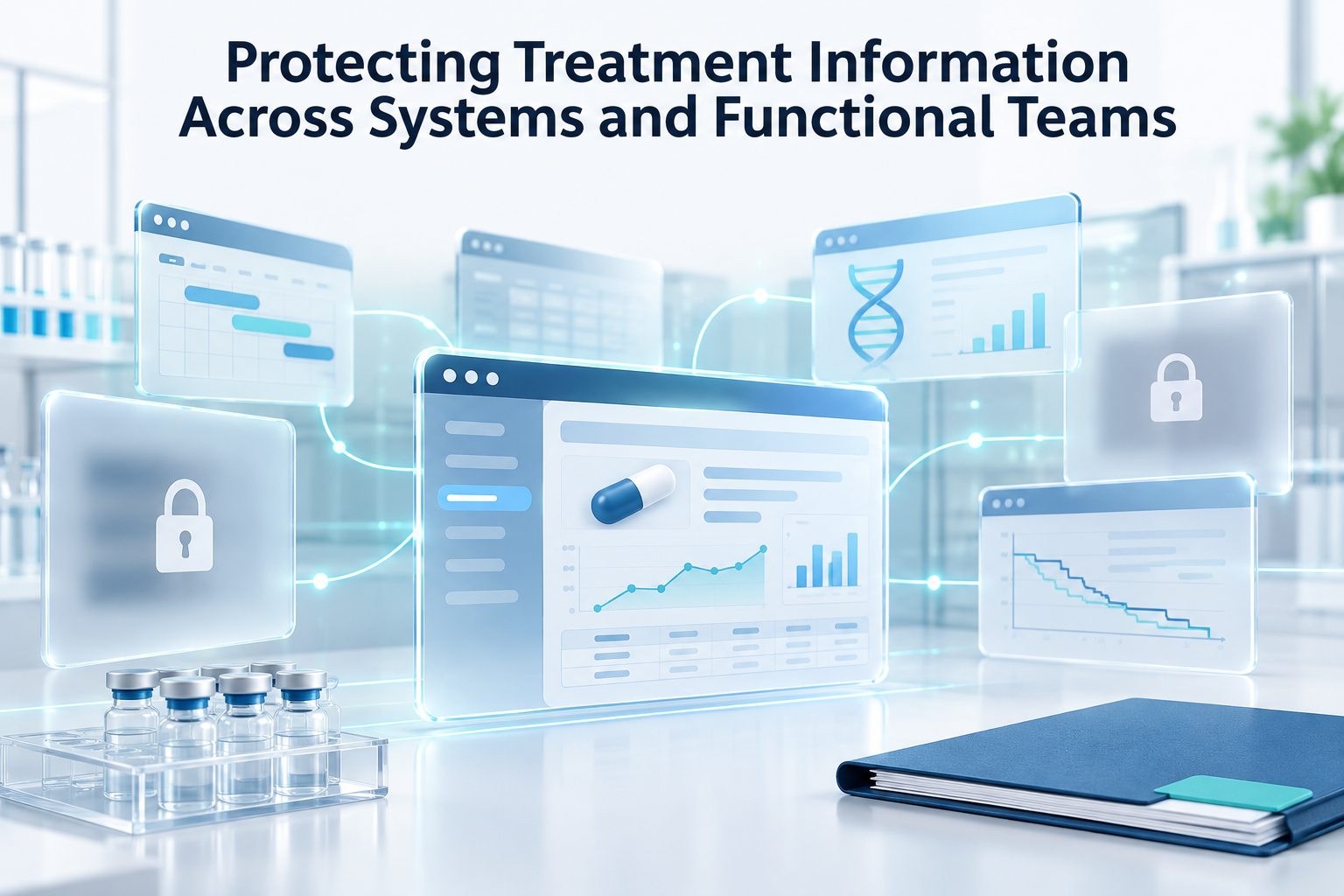
Maintaining blinding extends beyond the protocol. Clinical trial information may move through interactive response technology (IRT), electronic data capture systems, safety databases, laboratory reports, statistical datasets, and communication platforms. Each transfer or system interaction creates a point where access permissions and information handling require attention.
The European Medicines Agency’s 2023 guideline on computerised systems and electronic data in clinical trials states that unblinded information should be accessible only to predefined user roles. It also addresses testing and backup procedures for emergency unblinding within IRT systems. These provisions illustrate that maintaining blinding depends partly on system configuration and functionality, not simply on instructions to individual users.
ICH E6(R3) provides a broader perspective. Section 4.1 of the 2025 guideline addresses safeguarding blinding through system design, user account management, responsibilities for data handling, data transfers, and statistical analysis. It also calls for documented responsibilities and procedures governing access to unblinded information.
Consider a situation in which an authorized unblinded professional prepares a report that must be reviewed by a broader clinical operations team. The report may contain treatment identifiers or details that indirectly reveal allocation. Without an appropriate review of what can be shared, information intended for a restricted group could reach individuals who must remain blinded. This is an illustrative operational risk, not an assumption that such errors are routine.
Within an FSP arrangement, professionals may operate directly in sponsor-managed systems while collaborating with colleagues across organizations and regions. Access controls, training, report distribution, and communication procedures should therefore reflect each person’s trial-specific responsibilities. Functional integration can support collaboration, but it should not be interpreted as unrestricted access to study information.
Managing Necessary Unblinding Without Compromising the Wider Trial
Preserving blinding does not mean that treatment assignments must remain concealed under every circumstance. Participant safety may require an investigator to identify a treatment assignment during a medical emergency. Certain safety evaluations and regulatory reporting activities may also require authorized access to unblinded information.
ICH E6(R3) addresses both requirements. Investigators should be prepared to undertake emergency unblinding without undue delay when necessary to protect a participant. Sponsors should establish mechanisms that allow appropriate access while protecting the treatment assignments of other participants and maintaining the wider study blind. Planned and unplanned unblinding activities should also be documented and assessed as appropriate.
A specific regulatory example comes from the United Kingdom. The Medicines and Healthcare products Regulatory Agency (MHRA) guidance, updated in July 2026, describes circumstances in which treatment allocation must be revealed for safety evaluation and reporting. It emphasizes that information disclosed for these purposes should remain restricted to those who require it, while personnel responsible for ongoing trial conduct should generally remain blinded. These requirements must be interpreted within the applicable UK regulatory framework rather than assumed to apply identically in every jurisdiction.
The operational challenge is therefore not simply deciding whether unblinding is permitted. Teams must understand who is authorized to initiate it, who can receive the information, how the decision is documented, and which individuals must remain blinded afterward. In global trials, these arrangements need to be understood by the relevant clinical and safety functions, including appropriately assigned external professionals.
For FSP teams, this requires functional expertise that extends beyond completing an assigned task. Professionals supporting clinical monitoring, safety activities, or data-related functions need to recognize when information falls outside their authorized access and follow the applicable procedures for handling it. The sponsor retains responsibility for ensuring that suitable arrangements exist, even when particular activities are performed by service providers.
Conclusion:
Blinding is not maintained by confidentiality statements alone. It depends on a coordinated operational structure in which treatment information is accessible to the right individuals, for the right purposes, at the appropriate time.
As sponsors work with specialized professionals across clinical monitoring, safety, data management, and other functional areas, the distinction between collaboration and information access deserves careful attention. Clear role definitions, appropriate system permissions, documented unblinding procedures, and trial-specific training help translate the principles of blinding into everyday clinical practice.
For integrated support structures such as ABRS’s FullSpectrum FSP model, the broader lesson is that functional expertise must operate within the sponsor’s study-specific requirements. The ability to collaborate across teams should remain compatible with the information boundaries established to protect participants and the reliability of clinical trial results.
Ultimately, preserving blinding is not about keeping teams disconnected. It is about ensuring that necessary collaboration does not compromise the conditions under which clinical evidence is generated.
