
By: ABRS- Academic Team
Introduction
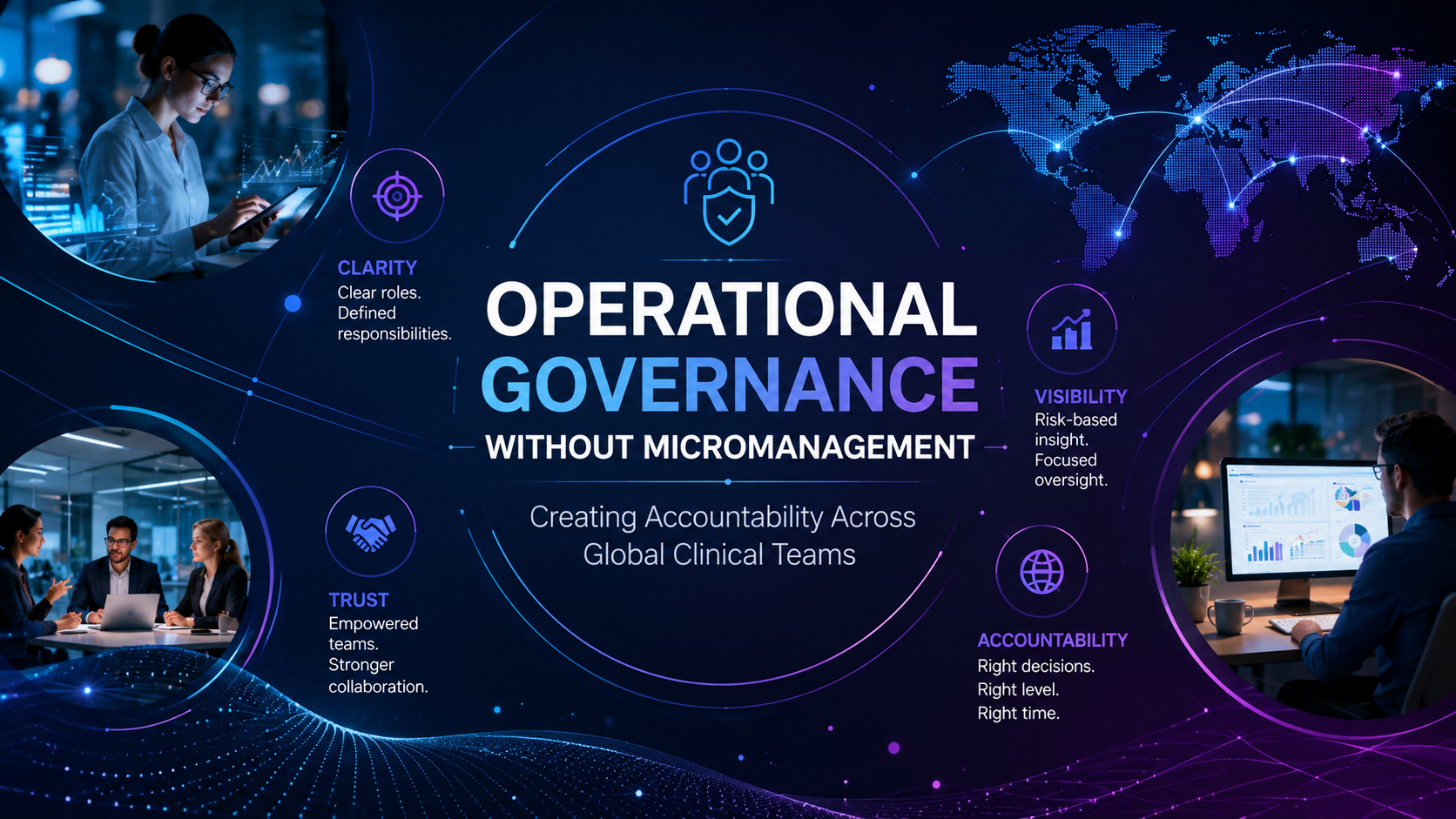
Global clinical trials require a level of coordination that goes far beyond assigning responsibilities across countries and functions. Sponsors need visibility into how teams are performing, how issues are being escalated, and whether operational risks are being addressed before they affect study quality. Yet too much intervention can create a different problem: slower decisions, duplicated effort, reduced ownership, and teams that become dependent on constant direction.
This balance becomes particularly important in Functional Service Provider (FSP) models, where professionals may work as an integrated extension of the sponsor’s clinical operations organization while remaining distributed across functions, regions, and reporting structures. In this environment, effective governance depends less on constant supervision and more on creating clear expectations, reliable communication, defined decision rights, and appropriate escalation pathways.
The challenge, then, is not whether global clinical teams need oversight—they do. The real question is how to maintain operational control without crossing into micromanagement.
Effective governance creates that balance. It gives sponsors the structure to maintain accountability while allowing experienced clinical professionals to exercise judgment, respond to local realities, and manage routine execution with appropriate autonomy. Achieving this requires more than frequent meetings or additional reporting. It depends on clear roles, meaningful visibility, and a governance framework that helps teams know when to act independently and when to escalate.
The sections below explore how sponsors can strengthen accountability across global clinical teams while preserving the autonomy and responsiveness that effective trial execution requires.
Accountability Starts With Clear Roles, Not Constant Supervision
One of the easiest mistakes in managing global clinical teams is to equate accountability with constant supervision. When responsibilities are unclear, leaders often compensate by adding meetings, requesting more frequent updates, or becoming involved in decisions that should be handled at the operational level. This may create the appearance of greater control, but it does not necessarily create stronger governance. Sustainable accountability begins with something more fundamental: every team member should understand what they own, what they are empowered to decide, and which issues require escalation.
This becomes particularly important when clinical operations are distributed across countries, sites, functions, and external or embedded teams. A 2026 qualitative study published in BMJ Open — “How do communication, trust and professional relationships shape decentralised clinical trials?” examined the experiences of 31 international stakeholders involved in decentralized and hybrid trials. The researchers found that unclear roles and expectations could contribute to coordination challenges, while clearly documented responsibilities and defined communication pathways were important for effective trial oversight. The study also highlights an important operational balance: teams described the need to maintain regular communication with sites without unnecessarily increasing the burden on investigators and site personnel.
The same principle can be seen at the sponsor–site interface. A 2026 study in the Journal of Clinical and Translational Science — “Bridging sponsor–site operations through reciprocal on-site training of CRAs and CRCs” explored how sponsor-side Clinical Research Associates (CRAs) and site-side Clinical Research Coordinators (CRCs) understood each other’s workflows. Greater exposure to counterpart responsibilities improved mutual understanding, and the authors concluded that this type of practical interaction may strengthen sponsor–site communication and collaboration.
For global clinical operations, the implication goes beyond sponsor–site relationships. Teams perform more effectively when governance makes the boundaries of responsibility visible. A CRA should understand which site-level issues can be resolved directly and which require escalation. A country lead should know where local judgment is appropriate and when a decision has broader study implications. Similarly, teams operating within an FSP structure need enough clarity around ownership, decision rights, and communication pathways to work as an integrated part of the sponsor organization without requiring approval for every routine action.
Operational governance, therefore, should not aim to eliminate independent decision-making. It should create a framework in which appropriate decisions can be made confidently at the right level, while issues with greater risk, quality, or study-wide implications remain visible to leadership. The clearer the boundaries of responsibility are, the less governance needs to depend on constant intervention.
Risk-Based Visibility: Knowing When to Intervene

Operational control becomes more effective when visibility is tied to risk, not to the volume of updates a team produces. In global clinical operations, leaders need enough information to identify emerging issues, performance gaps, and areas that may require escalation. But requiring constant reporting or intervening in routine activity can create unnecessary operational burden without improving decision quality.
A 2026 article from DIA Global Forum — “Clinical Research Associates (CRAs) and Risk-Based Monitoring (RBM): Perceptions and Experiences” reported findings from Tufts Center for the Study of Drug Development on CRA experience with risk-based monitoring. Among the themes identified were the importance of stronger collaboration between central monitors and CRAs, clearer dashboards, and more actionable information to help monitors determine where their attention was most needed. Rather than increasing oversight everywhere, the findings support a more targeted model in which visibility helps experienced professionals focus on the sites, data, and operational signals that require closer review.
The same principle is reflected in an FDA discussion on centralized statistical monitoring with Dr. Paul Schuette and Xiaofeng “Tina” Wang. FDA describes centralized monitoring as a way to identify patterns, outliers, and potential data-quality concerns across a study and to help sponsors direct additional attention where risk signals warrant it. Importantly, this approach is not about reducing vigilance. It is about using available information to make oversight more focused and proportionate.
A practical example of this type of model is described in ACRP Clinical Researcher — “Bridging the Monitoring Gap: A Structured Framework for Clinical Quality Management”. The Duke University framework described in the article adjusts the frequency and depth of quality review according to study complexity and risk, while allowing experienced reviewers to apply professional judgment when determining where closer evaluation is needed. Leadership still receives structured reporting and visibility, but not every study or activity is treated with the same level of scrutiny.
For global clinical teams, this distinction is critical. Effective governance should make it easier to see where intervention is needed while allowing routine execution to remain at the appropriate operational level. A missed milestone, repeated site issue, emerging quality trend, or unresolved escalation may justify leadership involvement. A routine decision that falls within an experienced team member’s defined responsibilities may not.
The goal is not maximum visibility into every activity. It is meaningful visibility into the risks, decisions, and performance signals that matter most.
Building Governance That Supports Autonomy Across Global Teams
Global clinical operations depend on professionals who can make informed decisions within their scope without waiting for constant direction. This is especially important when teams are working across countries, time zones, functional areas, and operating models such as FSP. In these environments, governance needs to provide structure without becoming so centralized that every routine issue requires additional approval.
A 2026 qualitative study published in BMJ Open — “How do communication, trust and professional relationships shape decentralised clinical trials?” found that communication, trust, and clarity of roles were central to coordinating work across distributed trial networks. The study also highlighted the importance of defining communication pathways and responsibilities early, particularly when multiple stakeholders are involved. For global teams, this supports a governance model in which people know not only what they are responsible for, but also when and how to involve others when an issue moves beyond their level of authority.
A similar operational principle appears in the 2026 study published in the Journal of Clinical and Translational Science — “Bridging sponsor–site operations through reciprocal on-site training of CRAs and CRCs”. The research showed that greater understanding of counterpart workflows, consultation pathways, and organizational structures helped sponsor-side CRAs and site-side CRCs better understand how decisions and responsibilities moved across the trial environment. This type of operational awareness can reduce unnecessary friction and help teams resolve issues at the appropriate level rather than automatically escalating every decision.
The importance of professional judgment is also reflected in ACRP Clinical Researcher — “Bridging the Monitoring Gap: A Structured Framework for Clinical Quality Management”. The Duke University framework described in the article combines structured quality review with flexibility, allowing experienced reviewers to adjust their approach according to study complexity and identified risk. At the same time, leadership maintains visibility through regular reporting and trend review. The model illustrates how operational structure and professional autonomy do not need to be competing priorities.
For sponsors managing global or FSP-integrated teams, this balance is essential. Governance should define expectations, decision boundaries, reporting mechanisms, and escalation triggers clearly enough that teams can operate confidently within them. When those elements are understood, leadership can stay informed without becoming involved in every operational detail, while teams retain the flexibility to respond to local conditions and study-specific needs.
Effective governance creates autonomy within defined boundaries. The objective is not to remove oversight, but to design it so that experienced teams can act independently when appropriate and escalate quickly when the risk, quality, or study impact requires broader attention.
Conclusion:
Operational governance in global clinical trials is most effective when it creates clarity, visibility, and accountability without slowing the people responsible for execution. Strong oversight does not require leaders to remain involved in every routine decision. It requires teams to understand what they own, which risks deserve closer attention, and when an issue needs to move beyond the operational level.
As clinical teams become more distributed across regions, functions, and FSP structures, this balance becomes increasingly important. Clear roles, actionable information, defined escalation pathways, and proportionate oversight can help sponsors maintain confidence in execution while preserving the professional judgment of experienced clinical teams.
Ultimately, the goal of governance is not tighter control for its own sake. It is to create an operating environment in which teams can act with autonomy, leadership can maintain meaningful visibility, and important risks can be identified and addressed before they compromise trial quality or execution.
