
By: ABRS- Academic Team
Introduction
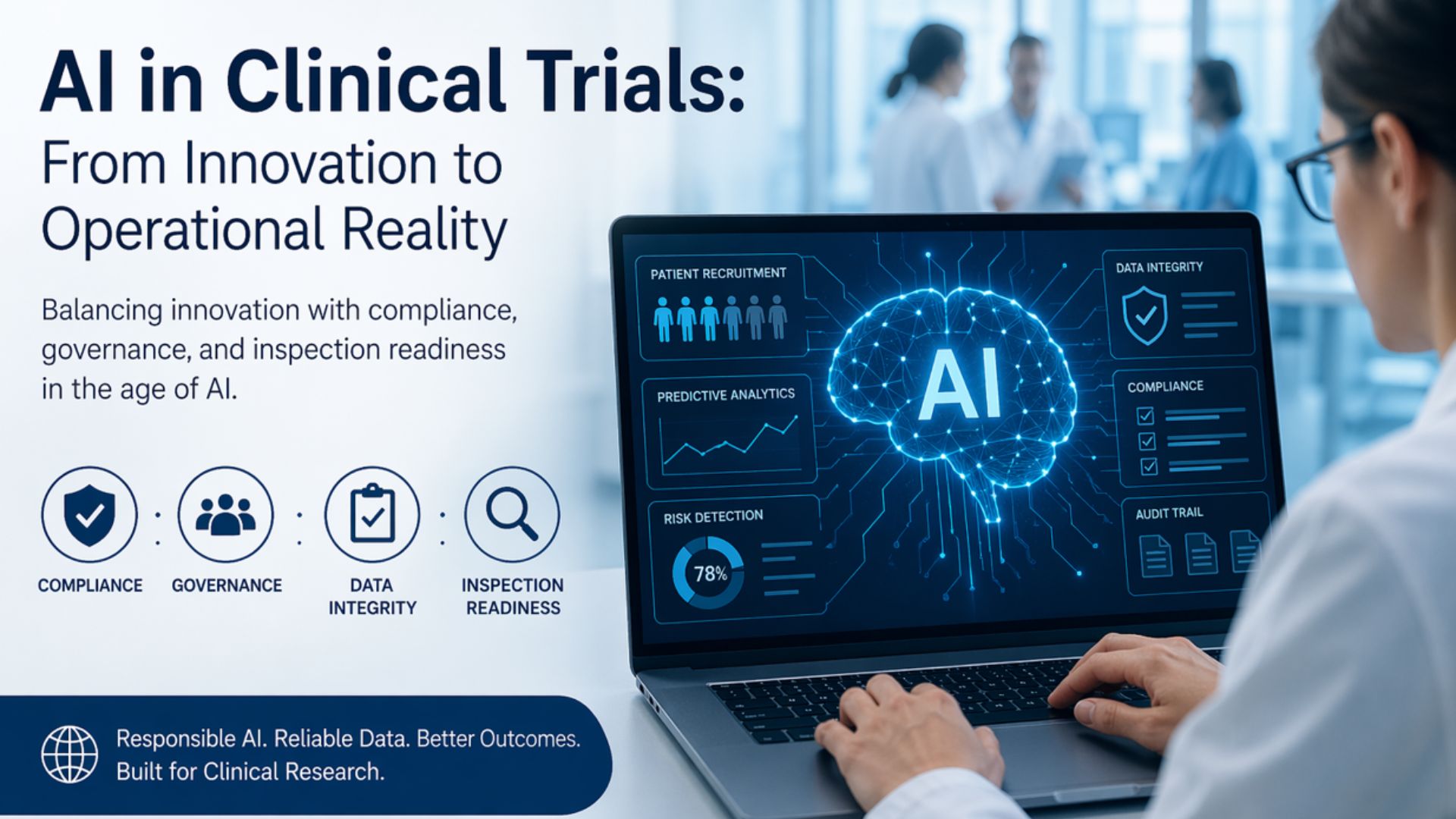
The growing interest in artificial intelligence (AI) across clinical research reflects a broader industry push toward greater efficiency, faster timelines, and more data-driven decision-making. From patient recruitment to risk detection and data review, AI-enabled tools are increasingly being explored to support critical aspects of clinical trial execution.
However, as adoption accelerates, so does the need for clarity. Clinical trials operate within highly regulated frameworks, where data integrity, patient safety, and traceability are non-negotiable. Integrating AI into this environment is not simply a matter of technological capability—it introduces important operational and regulatory considerations that organizations must address with care.
As the industry moves beyond experimentation, the focus is shifting toward a more practical question: how can AI be implemented in clinical trials in a way that supports innovation while maintaining compliance and inspection readiness?
From Innovation to Operational Reality
Artificial intelligence is rapidly transitioning from a conceptual innovation to a practical tool within clinical trial operations. Across the industry, AI is being explored to support functions such as trial design optimization, patient recruitment, and data analysis—areas traditionally constrained by time, cost, and operational complexity.
Industry analyses indicate that AI has the potential to improve trial efficiency by enabling more adaptive study designs, accelerating patient identification, and supporting more data-driven decision-making. In an article examining the implications of the FDA’s draft guidance, RealTime eClinical highlights that AI-driven approaches can enhance recruitment strategies and optimize protocol design through the use of large-scale clinical and real-world data (RealTime eClinical, 2025).
At the same time, regulators are formally acknowledging the growing role of AI in drug development. The European Medicines Agency (EMA) and the U.S. Food and Drug Administration (FDA) have outlined shared principles for the use of AI across the medicinal product lifecycle, including clinical development, emphasizing the importance of reliability, transparency, and regulatory oversight (European Medicines Agency, 2026).
However, this shift from experimentation to implementation introduces new operational realities. AI-driven processes must now coexist with established GCP frameworks, requiring organizations to ensure that efficiency gains do not come at the expense of traceability, validation, and regulatory compliance.
The Compliance Challenge: What Changes with AI?

The integration of artificial intelligence into clinical trials does not simply enhance existing processes—it fundamentally reshapes how decisions are generated, documented, and validated within regulated environments. Unlike traditional rule-based systems, many AI models—particularly those based on machine learning—introduce variability and adaptability that challenge established compliance frameworks.
One of the most critical considerations is validation. In traditional GxP systems, validation ensures that a system performs consistently according to predefined specifications. However, AI models may evolve over time as they are exposed to new data, raising questions about when and how re-validation should occur. According to a 2025 report by the U.S. Food and Drug Administration (FDA), AI/ML-based systems require a lifecycle-based approach to oversight, where performance, data inputs, and model changes are continuously monitored rather than assessed only at a single point in time (U.S. Food and Drug Administration, 2025).
In parallel, traceability and explainability are emerging as key regulatory expectations. Clinical trial processes must remain fully auditable, yet some AI models—particularly complex ones—can function as “black boxes,” making it difficult to clearly explain how specific outputs or decisions were generated. The World Health Organization has emphasized that transparency and explainability are essential for the responsible use of AI in health, noting that systems must allow for meaningful human oversight and accountability, especially in high-risk contexts such as clinical research (World Health Organization, 2025).
These challenges extend into operational consistency. Ensuring that AI-generated outputs are reproducible across different datasets, study phases, or geographic regions is critical for maintaining data integrity and regulatory confidence. Variability in training data, model updates, or implementation contexts can introduce unintended discrepancies—potentially impacting trial outcomes or regulatory submissions.
As a result, organizations must rethink traditional compliance models. Rather than relying solely on static validation frameworks, there is a growing need for continuous oversight, robust documentation practices, and clearly defined accountability structures that align with evolving regulatory expectations.
Operational Governance: Establishing Control in AI-Enabled Trials
As artificial intelligence becomes more embedded in clinical trial processes, the need for robust operational governance is no longer optional—it is essential. While AI can enhance efficiency and support decision-making, it also introduces new layers of risk that must be actively managed through structured oversight.
A key challenge is defining accountability. In traditional clinical operations, responsibility for decisions is clearly assigned to qualified personnel. However, when AI tools contribute to—or influence—those decisions, organizations must ensure that accountability remains firmly with human oversight. This includes clearly documenting who reviews, validates, and ultimately approves AI-driven outputs within the trial lifecycle.
Recent regulatory developments reinforce this shift toward structured governance. The U.S. Food and Drug Administration (FDA) continues to emphasize a risk-based, lifecycle approach and human oversight for AI/ML systems used in regulated environments, including those supporting clinical development (FDA, updated 2025).
In parallel, global policy frameworks are being operationalized across industries, including healthcare. The National Institute of Standards and Technology (NIST) AI Risk Management Framework—actively referenced and adopted in ongoing AI governance discussions through 2025—highlights the need for governance structures, transparency, accountability, and continuous monitoring when deploying AI in high-risk environments (NIST, 2024–2025 adoption).
Operationally, this translates into several critical components:
- Defined governance frameworks for AI use across the trial lifecycle
- Standardized validation and change control processes
- Clear documentation practices to support auditability and inspection readiness
- Cross-functional oversight structures to align technical and regulatory expectations
Without these controls, the benefits of AI can quickly be offset by increased regulatory risk and operational inconsistency.
For organizations operating globally, governance must also account for regional regulatory expectations, data privacy requirements, and varying levels of AI maturity across jurisdictions, adding another layer of operational complexity.
Conclusion:
As artificial intelligence continues to gain ground in clinical research, its long-term value will not be defined solely by technological advancement, but by how effectively it is integrated into regulated environments. The shift from experimentation to implementation is already underway, and with it comes a clear expectation: innovation must be accompanied by control.
AI has the potential to enhance efficiency, strengthen risk detection, and support more informed decision-making across the clinical trial lifecycle. However, these benefits can only be realized when supported by robust governance frameworks, clear accountability, and adherence to established regulatory principles such as GCP and data integrity standards.
For sponsors, CROs, and clinical teams, the priority is no longer whether to adopt AI, but how to do so responsibly. This includes ensuring that AI-driven processes remain transparent, validated, and inspection-ready—while maintaining human oversight as a central component of all critical decisions.
Ultimately, the successful integration of AI in clinical trials will depend on an organization’s ability to balance innovation with operational discipline. Those that can align emerging technologies with strong quality and compliance frameworks will be better positioned to navigate increasing trial complexity and evolving regulatory expectations.
